 Posted by
By: William Joshua Levesque (Class of 2025)
It was the very first day of my internship at the 7th Judicial District Court in Ontario County Supreme Court. The trial took place in the same courtroom where Susan B. Anthony was tried for voting. The courtroom was old-style. Across three of the walls were portraits of past judges. Long windows allowed light into the court room.
As I entered the courtroom, the defense was cross-examining the victim of this alleged assault and battery. The Defendant had two attorneys, one who was local (he will be referred to as “H”), and a New York City attorney (he will be referred to as “C”). It was a mystery as to why the Defendant also hired a lawyer from New York City if she already had an attorney. C stood and crossed-examined the victim.
Just like a movie out of Hollywood, everyone gasped and murmured to themselves. The Prosecutor stood up and demanded that the jury be dismissed. The judge quickly sent the jury out of the courtroom. Once the jury left, the Prosecutor requested that a mistrial be issued, and if it was not issued, that a carefully worded instruction be given to the jury, in addition to sanctions. The judge said the trial will continue. The Judge turned and focused on C. While this occurred, the Prosecution left the court room. Minutes later, the Prosecutor came back with the District Attorney. The District Attorney addressed the Judge and said, “In my experience of the law, I have never seen something like this! I don’t know how they conduct things in New York City, but that is something we never do here! Someone should check to see if C even has a license to practice!”
C: You’ve been previously arrested three times in the past, is that correct?
Victim: Yes.
C: And these arrests were based off grand larceny?
Victim: Yes.
A couple of minutes later…
C: Have you ever been in possession of a firearm?
Victim: Yes.
C: Did you have a permit for that firearm?
Victim: No.
C: Did you know that is a third-degree federal felony?
Victim: Uh—no.
C: Your Honor, I don’t think we can continue. She must be arrested at once!
C rose and asked why everyone was picking on him. The Prosecutor and the District Attorney left and came back with an instruction for the Judge to give to the jury. The jury came back out, and the judge issued the instruction, and dismissed court for the day.
The next day, I went down to the court room to find that something else had occurred. C wrote a brief the night before; the problem is that C never sent the brief to the Prosecutor. The judge asked for the Prosecutor’s thoughts on the brief, but he never received a copy. C gave a shrug of the shoulder as to why the Prosecutor was not sent a copy. The judge gave the Prosecutor a few minutes, but this was not enough time to truly digest it. I was able to receive a copy, however, it was sloppily written and hard to understand at times. It was everything we were told not to do in legal writing. Almost every paragraph was just giant quotes, and quotation marks were used when he was not quoting anything.
In addition, C went on his own soliloquy. “I know you all have known each other here for a long time. None of you know me, so let me really introduce myself. My name is C. I am from New York City. I just used a gender-neutral bathroom for the first time, I don’t really know what that is. I also fought the Governor on the constitutionality of her mask and vaccine mandates.” Most people in the court room believe he was trying to appeal to a Republican sentiment due to how red Ontario County is. “But this isn’t about me! This is about my client. Although, I feel like Joe Pesci in ‘My Cousin Vinny’.”
The trial continued. The victim was cross-examined by C again. This time C was asking how the victim was thrown into the gravel driveway by the Defendant.
C: So, how did you fall into the gravel?
Victim: Me and the Defendant were wrestling with each other after she first came at me. She managed to throw me to the ground and then she sat on me and kissed me.
C: Would you say that you were able to see the rocks?
Victim: Yes, I faceplanted into them.
C: Were the rocks pointy?
Victim: It’s gravel, it’s all different shapes and sizes.
C: Were the rocks big?
Victim: Like I said, it’s gravel, it’s all different shapes and sizes.
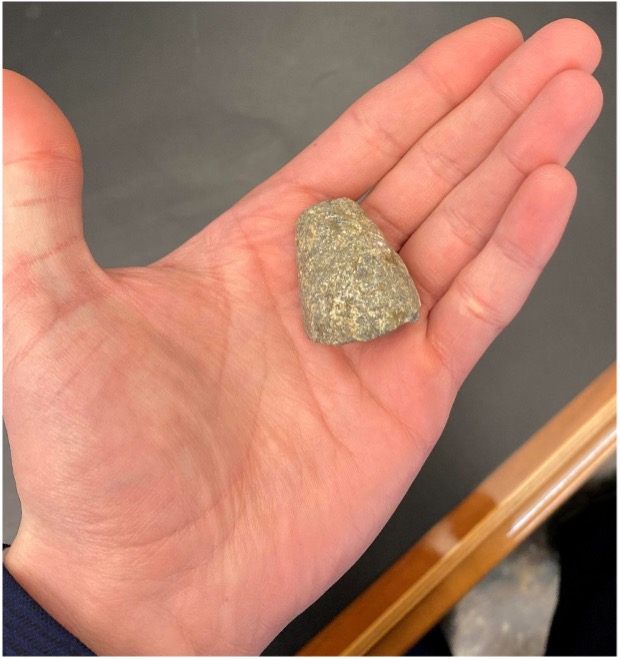
C reaches into his pocket and declares: Did it look like THIS?! C showcased a rock, about two inches in length, rounded at the top, with a semi-jagged bottom. The Prosecutor stood and demanded that the jury be sent out of the courtroom. After the jury was sent out, the Prosecutor requested another mistrial, which the judge declined. The Judge turned concerningly towards C.
Judge: Where did you get the rock?
C: I went to the Defendant’s house last night and picked it up from her driveway.
Judge: I—I’m warning you now (waving his finger), you’re really trying my patience. I have a lot of patience, but it only goes so far.
C: I understand.
Judge: Get rid of the rock.
C: How would you like me to—
Judge: Throw it out the window.
Before C could throw it out the window, the bailiff came with a small trashcan and C tossed the rock into the trash. Eventually, the jury was brought back out, and the cross-examination continued. By this time, the courtroom was filled with different employees of the courthouse as well as attorneys, all coming to witness the trial.
The third day was mostly uneventful. The judge’s clerk, however, went into the trashcan the night before when everyone left, and gave me the rock. The expert witness was cross-examined, for there was a gun involved that may have had the victim’s blood on the barrel. The victim claimed she was also pistol-whipped. The third day was carried out by H in the Defense, C remaining silent.
On the fourth day, witnesses to the alleged assault and battery were questioned and cross-examined. Nothing particularly eventful happened. It was good to see how the Prosecution tried to poke holes in the Defense’s witness, in how the witness’ motives were contradictory.
On the fifth day, it was time for closing arguments. C gave the closing argument for the Defense. “You saw how [the victim] looked. Due to the laws of gravity, she should’ve hit the gravel even harder.” Essentially saying because of how heavy the victim was, the weight should’ve made her condition worse. For five minutes, C constantly referenced “the laws of gravity.” C also gave an analogy, “In order to prove that you have a fever, you need to take a thermometer and show everyone the temperature. This is more like a stomachache, where it’s on the inside, subjective, and you can’t prove it to other people.”
After hours of deliberation, the jury came back with a not-guilty plea, to the surprise of everyone in attendance. During the many breaks that week, almost all the lawyers I spoke to said, “Do not be like C.” Well, C won. There were plenty of what not to-do’s during the week, some of which I already knew and some I learned. I also learned some objections, just completing 1L, I do not know when to call objections or what is objectionable. It was an educational and exciting experience at the same time. It was an eye-opening opportunity of what trials could really look like.
I want to thank the donors of the Freudenheim Fellowship, as well as the University of Buffalo School of Law Summer Public Interest Funding & Fellowship Program, for allowing me to have the opportunity to work in this court where I am learning more about the inner workings of cases and trials. It has given me a real look into what an attorney’s work looks like.

Name: William Levesque ’25
Name of Fellowship: Freudenheim Fellowship
Name of Placement: New York Supreme Court, Ontario County Court
Location: Canandaigua, New York
One important lesson I learned from my fellowship: “Almost every criminal case gets plead out, nearly none go to trial. The best thing a defense attorney may be able to do is negotiate a good plea deal and poke holes in the prosecution’s argument.”
 UB School of Law Responds