 Posted by
By: Natalia Beltre ’25
On the day I was sworn in for my internship with Judge Fuentes at the Third Circuit Court of Appeals, I was nervous and excited about the opportunity. Although I had previous experience in the legal field, I had never worked for a judge before. While I spent the summer observing oral arguments and attending virtual programs held by the District Court for the District of New Jersey, completing writing assignments was my favorite activity.
Every week, I would summarize a new precedential opinion for the judge’s review. This was challenging for me, as I used to write lengthy case briefs during my 1L year and struggled with extracting the most important information. Each new precedential opinion was a chance to strengthen my ability to grasp novel legal issues and distill each opinion to its most essential parts. As I completed each memo, law clerks would provide me with detailed feedback. I tried to use this feedback to improve my writing so that it was concise, clear, and flowed well.
In addition to the weekly memos, I wrote the first draft of a nonprecedential opinion under the supervision of a law clerk. Like many 1Ls, I have written objective memos detailing how a court would likely decide on legal issues, as well as a brief where I tried to put forth my best argument to win in court. I quickly realized it is quite a different feat when you are tasked with making the decision.

At first, writing the opinion felt like any other writing assignment I completed in law school. I started the process by reading the briefs and Appendix while simultaneously outlining each asserted argument. I wrote the facts section and then focused on reading and organizing the cases cited in the briefs. By using a table to organize the cases, I was able to see the big picture of how the rules worked and how cases were analyzed. Writing the rule statement was a breeze, given all the practice I had during my 1L year. But the process became tricky once I reached the application portion of the opinion.
Even though I knew the final decision would not be up to me, I took the task seriously and felt the weight of having to decide. Keeping the standard of review in mind, I tackled the application section rule by rule. I relied heavily on the briefs and my table of cases to see where I could analogize and distinguish the facts of the matter to case law. Outlining the arguments proved to be helpful because whenever I felt stuck on the details, the outline helped me focus on assessing and responding to the arguments in the briefs. Completing the opinion came with great relief and pride, as that was the most challenging writing assignment I ever had.
Finally, I would like to thank my sponsor Hon. Dennis C. Vacco for his generous donation to the University at Buffalo School of Law Summer Public Interest Funding & Fellowship Program that made this fellowship possible. I would also like to thank Judge Fuentes and his talented law clerks for this amazing opportunity to learn the inner workings of the appellate court system. I am so grateful to everyone that contributed to my summer experience.
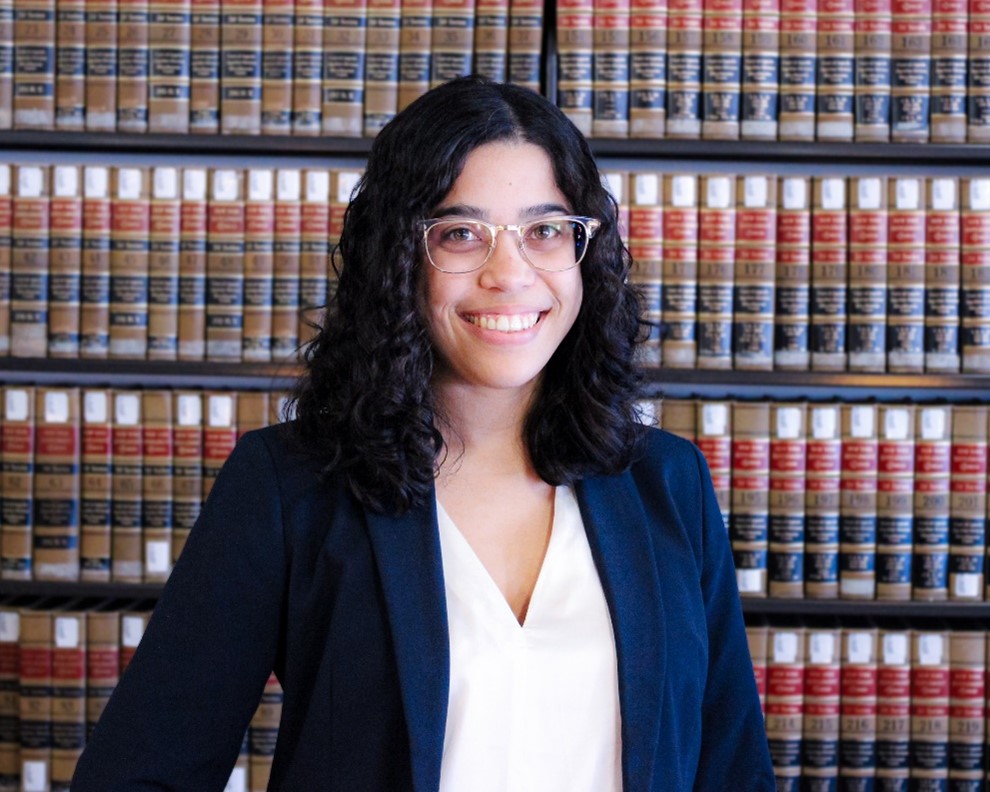
Name: Natalia Beltre ’25
Fellowship: 2023 Hon. Dennis C. Vacco ’78 Summer Fellowship
Placement: United States Court of Appeals for the Third Circuit
Location: Philadelphia, PA
One important lesson I have learned from this fellowship: “I learned how to summarize complex judicial opinions succinctly, which I’m sure will be a valuable skill for school this semester.”
 UB School of Law Responds